
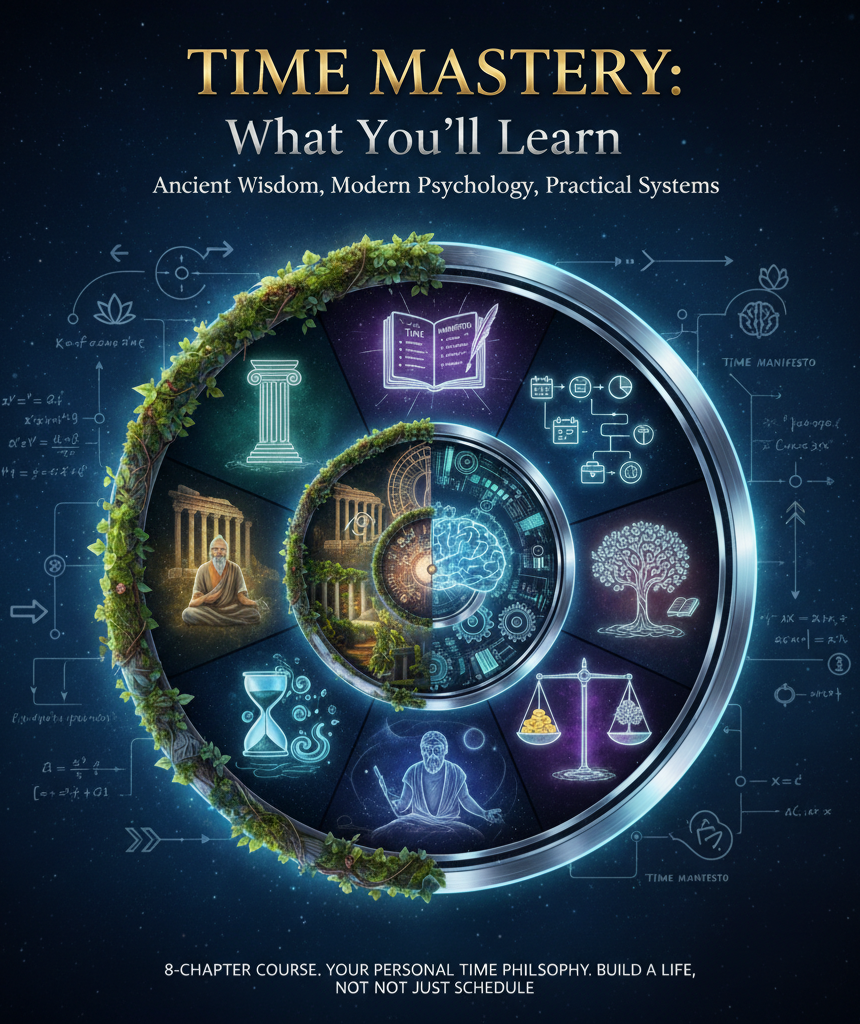
Most time management courses teach you shortcuts and hacks. This one teaches you something deeper: how to think about time itself.
Time Mastery: The Philosophy of Time and How To Use It Wisely isn’t just another productivity guide filled with calendar templates and to-do list tricks. It’s a comprehensive exploration of what time really is, how humans have understood it across centuries, and how you can build a personal philosophy that transforms the way you live every single day.
Why Philosophy Matters for Time Management
You’ve probably tried productivity systems before. Maybe you’ve used the Pomodoro Technique, blocked your calendar, or downloaded the latest app promising to “save time.” Yet somehow, you still feel overwhelmed, rushed, and like you’re never doing enough.
Here’s why: You can’t manage time effectively without understanding what time means to you.
Time Mastery takes you beyond surface-level tactics into the foundational questions:
- Is time a resource to manage or a flow to enter?
- Should you optimize every moment or embrace intentional leisure?
- How do ancient philosophies—Stoicism, Taoism, Buddhism—change your approach to daily schedules?
When you understand time philosophically, you stop chasing productivity for its own sake and start aligning your hours with what actually matters.
What You’ll Learn in Time Mastery
This 8-chapter course combines ancient wisdom, modern psychology, and practical systems into a complete time philosophy education:
Chapter 1: What Is Time?
Explore the mystery of time itself—from the Greek concepts of Chronos (measured time) and Kairos (meaningful moments) to the scientific and philosophical debates about whether time is “real” or a human construct. You’ll examine how your personal view of time—linear, cyclical, or something else—shapes every decision you make.
Chapter 2: The Wisdom of the Ancients
Learn from history’s greatest thinkers about time:
- Stoic philosophers like Seneca and Marcus Aurelius who taught that life is short and every moment counts
- Aristotle and Aquinas who connected time to purpose and movement
- Taoist and Buddhist traditions emphasizing flow, impermanence, and presence
Each tradition offers practical lessons you can apply today.
Chapter 3: The Psychology of Time
Discover why an hour of boredom feels endless while an hour of joy vanishes instantly. You’ll explore:
- Philip Zimbardo’s six time perspectives (Past-Positive, Future-Oriented, Present-Hedonistic, and more)
- Mihaly Csikszentmihalyi’s concept of “flow states” where time disappears
- How your brain’s perception of time affects your daily experience
Understanding time psychology helps you design activities that feel both productive and fulfilling.
Chapter 4: The Ethics of Time
Time isn’t just practical—it’s moral. This chapter examines time as the ultimate non-renewable resource and explores ethical questions like:
- Is “wasting time” always wrong, or can leisure be a moral good?
- How does respecting others’ time relate to fairness and justice?
- Why is rest not selfish but a responsibility?
You’ll learn why self-care and intentional leisure are ethical obligations, not luxuries.
Chapter 5: Philosophical Schools of Time Management
Apply four major philosophical approaches to your real-world schedule:
- Stoic Time Management: Focus only on what you control
- Existentialist Time Management: Choose meaning through deliberate action
- Pragmatist Time Management: Adapt flexibly to what actually works
- Minimalist Time Management: Subtract the non-essential to focus on what matters
Each philosophy comes with practical applications you can test immediately.
Chapter 6: Modern Systems in Philosophical Context
See popular productivity methods through a philosophical lens:
- The Eisenhower Matrix: Urgency vs. importance
- Getting Things Done (GTD): Externalizing your mind for clarity
- Deep Work: Depth over distraction
- The 80/20 Principle: Where does your effort create the most value?
Understanding the “why” behind these systems helps you choose which ones actually fit your life.
Chapter 7: The Paradox of Time
Confront the contradictions in how we think about time:
- Why busyness doesn’t equal productivity
- How the scarcity mindset (“I don’t have enough time”) often signals misalignment, not actual lack
- What “time affluence” means and why it’s the real measure of wealth
- How awareness of mortality can liberate rather than burden you
This chapter reframes time from something you chase into something you design.
Chapter 8: Building Your Time Philosophy (Capstone)
The course culminates in creating your personal Time Manifesto—a declaration of:
- Your core time values (freedom, legacy, presence, service?)
- Daily and weekly rituals that reflect those values
- Boundaries that guard against “time theft”
- Your definition of “enough”
This manifesto becomes your compass when busyness and distraction threaten to pull you off course.
Who This Course Is For
Time Mastery is perfect for:
- Professionals who feel busy but not productive
- Entrepreneurs struggling to balance multiple priorities
- Students learning to manage their schedules independently
- Anyone tired of surface-level productivity hacks that don’t create lasting change
- People seeking a deeper understanding of how to live intentionally
This course is NOT for:
- People looking for quick tips or overnight productivity fixes
- Anyone unwilling to reflect deeply on their values and habits
- Those seeking pre-made schedules rather than personalized philosophies
How Time Mastery Works
Each chapter includes:
- Comprehensive Teaching: Deep exploration of concepts with clear explanations
- Reflection Prompts: Thought-provoking questions that help you apply ideas to your life
- Practical Assignments: Hands-on exercises like tracking your time perception, testing philosophical approaches for a week, or designing rituals
The course is delivered as a downloadable PDF, allowing you to work at your own pace, revisit chapters as needed, and build your time philosophy over weeks or months.
Why Time Philosophy Matters More Than Time Hacks
Here’s the truth about productivity systems: they only work when they align with how you naturally think and what you deeply value.
You can’t force yourself into someone else’s routine—not permanently. But when you understand your own philosophy of time, every system you choose becomes an extension of your values rather than a constraint fighting against them.
Time Mastery teaches you to think philosophically so you can act practically. It’s the foundation beneath every schedule, calendar, and commitment you’ll make for the rest of your life.
From Ancient Wisdom to Modern Mastery
The greatest minds in history—from Marcus Aurelius to Mihaly Csikszentmihalyi—understood something essential: time is not just about doing more; it’s about living well.
Time Mastery brings their insights together into one comprehensive course, showing you how philosophy transforms from abstract theory into daily practice.
You’ll finish this course with:
- A personal Time Manifesto guiding your decisions
- Practical rituals aligned with your values
- A deeper understanding of why you do what you do
- The confidence to say no to what doesn’t matter and yes to what does
Learn the Systems. Master Your Life. Achieve Time Freedom.
Most people spend their lives reacting to urgency, chasing busyness, and wondering why they never have enough time. Time Mastery shows you another way—a philosophical approach that turns time from an enemy into an ally.
This isn’t about squeezing more productivity from your day. It’s about designing a life where your time reflects your values, your actions align with your purpose, and your hours feel like they’re genuinely yours.
Ready to build your time philosophy?
Explore Time Mastery: The Philosophy of Time and How To Use It Wisely and discover how ancient wisdom combined with modern psychology can transform the way you live every single day.
Kelly T. Boyd
Author & Founder, The Image Writer
Looking for more life-changing courses? Check out Roundbottom’s Stack Your Life, or Penny Stox’s Essential Stock Investing Guide to master other critical areas of your life.